Desmond Tutu
The Death Penalty Is Currently Legal in 32 States
On May 2, 2013, Maryland became the latest state to outlaw capital punishment, joining 17 other states and the District of Columbia.
 The non-death penalty states are Alaska, Connecticut, Hawaii, Illinois, Iowa, Maine Maryland, Massachusetts, Michigan, Minnesota, New Jersey, New Mexico, New York, North Dakota, Rhode Island, Vermont, West Virginia, and Wisconsin.
The Death Penalty Is Not a Deterrent
FBI data shows that the 14 states without the death penalty in 2008 had homicide rates at or below the national rate.

A report by the National Research Council stated that studies claiming that the death penalty had a deterrent effect on murder rates are "fundamentally flawed" and should not be used when making policy decisions.
The 2011 FBI Uniform Crime Report showed that the South had the highest murder rate. The South accounts for over 80% of executions. The Northeast which has less than 1% of all executions, had lowest murder rate.
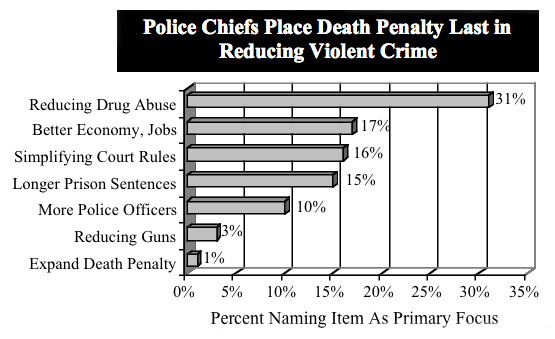
A 2009 poll commissioned by DPIC found police chiefs ranked the death penalty last among ways to reduce violent crime.
The Death Penalty Is Not Popular Around the World
Over two-thirds of the countries in the world-141-have now abolished the death penalty in law or practice.
At least 21 countries were known to have carried out judicial executions in 2012. At least 682 executions were carried out in 2012. This figure does not include the thousands of executions that were believed to be carried out in China. Beginning in 2009, Amnesty International ceased to publish minimum figures for the use of the death penalty in China, where such statistics are considered to be state secrets.
| Countries with the Most Confirmed Executions in 2012 | |
1. China (1,000s) | 4. Saudi Arabia (79+) |
2. Iran (314+) 3. Iraq (129+) | 5. United States (43) |
| 6. Yemen (28+) | |
The Death Penalty Is Racially Biased
Since 1977, the overwhelming majority of death row defendants (77%) have been executed for killing white victims, even though African Americans make up about half of all homicide victims.
In Louisiana, the odds of a death sentence were 97% higher for those whose victims was black. (Pierce & Radelet, Santa Clara Law Review, 2005)
A study in California found that those who killed whites were over 3 times more likely to be sentenced to death than those who killed blacks and over 4 times more likely than those who killed Latinos. (Pierce & Radelet, Santa Clara Law Review, 2005)
A comprehensive study of the death penalty in North Carolina found that the odd of receiving a death sentence rose by 3.5 times among those defendants whose victims were white, (Prof. Jack Boger and Dr. Isaac Unah, University of North Carolina, 2001)
The Death Penalty Claims Innocent Lives
Since 1973, 140 people have been released from death rows with evidence of their wrongful conviction. (Staff Report, House Judiciary Subcommittee on Civil and Constitutional Rights, Oct. 1993 with updates from DPIC)
In 2001, the Center on Wrongful Convictions at Northwestern Law School analyzed the cases of 86 death row exonerees. They found a number of reasons why innocent people are wrongly convicted in capital cases. 45 death row inmates were released due to eyewitness error, 10 because of snitch testimony, 17 due to government misconduct, 8 due to false confession, 9 due to junk science, 29 due to other reasons such as hearsay, questionable circumstantial evidence, etc.
The Death Penalty Costs More
The greatest costs associated with the death penalty occur prior to and during trial not in appeals. Even if all appeals were abolished, the death penalty would still be more expensive then alternative sentences.
In Maryland an average death penalty case resulting in a death sentence costs approximately $3 million. The eventual costs to Maryland taxpayers for cases pursued 1978-1999 will be $186 million. Five executions have resulted. (Urban Institute, 2008)
In Kansas, the costs of death penalty cases are 70% more expensive than non-death penalty cases, including the costs of incarceration. (Kansas Performance Audit Report, December 2003)
Enforcing the death penalty costs Florida $51 million a year above what it would cost to punish all first-degree murderers with life in prison without parole. Based on the 44 executions Florida had carried out since 1976, that amounts to a cost of $24 million for each execution. (Palm Beach Post, January 4, 2000)
The most comprehensive study in the country found that the death penalty costs North Carolina $2.16 million per execution over the costs of sentencing murderers to life imprisonment. The majority of those costs occur at the trial level. (Duke University, May 1993)
In Texas, a death penalty case costs an average of $2.3 million, about three times the cost of imprisoning somone in a single cell at the highest security level for 40 years. (Dallas Morning News, March 8, 1992)

The Death Penalty May Be Unconstitutional
The Death Penalty Is Unfair To the Poor
Almost all death row inmates could not afford their own attorney at trial. In many cases, the appointed attorneys are overworked, underpaid, or lacking the trial experience required for death penalty cases.
There have even been instances in which lawyers appointed to a death case were so inexperienced that they were completely unprepared for the sentencing phase of the trial. Other appointed attorneys have slept through parts of the trial, or arrived at the court under the influence of alcohol.
In 2001, U.S. Supreme Court Justice, Ruth Bader Ginsburg commented: "People who are well represented at trial do not get the death penalty . . . I have yet to see a death case among the dozens coming to the Supreme Court on eve-of-execution stay applications in which the defendant was well represented at trial."
Besides inept lawyers, local politics, the location of the crime, plea bargaining, and pure chance affect the process and make it a lottery of who lives and dies.
