Thursday, December 12, 2013

The Death Penalty: What Is It Good For?

                   "To take a life when a life has been lost is revenge, not justice."
                                                                        Desmond Tutu


The Death Penalty Is Currently Legal in 32 States

 On May 2, 2013, Maryland became the latest state to outlaw capital punishment, joining 17 other states and the District of Columbia.

The non-death penalty states are Alaska, Connecticut, Hawaii, Illinois, Iowa, Maine Maryland, Massachusetts, Michigan, Minnesota, New Jersey, New Mexico, New York, North Dakota, Rhode Island, Vermont, West Virginia, and Wisconsin.


The Death Penalty Is Not a Deterrent

FBI data shows that the 14 states without the death penalty in 2008 had homicide rates at or below the national rate.


A report by the National Research Council stated that studies claiming that the death penalty had a deterrent effect on murder rates are "fundamentally flawed" and should not be used when making policy decisions.

The 2011 FBI Uniform Crime Report showed that the South had the highest murder rate. The South accounts for over 80% of executions. The Northeast which has less than 1% of all executions, had lowest murder rate.

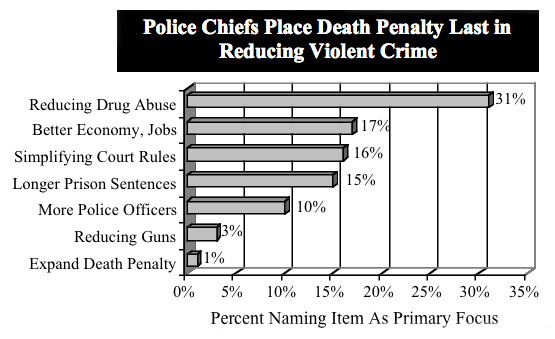
A 2009 poll commissioned by DPIC found police chiefs ranked the death penalty last among ways to reduce violent crime.


The Death Penalty Is Not Popular Around the World

Over two-thirds of the countries in the world-141-have now abolished the death penalty in law or practice.

At least 21 countries were known to have carried out judicial executions in 2012. At least 682 executions were carried out in 2012. This figure does not include the thousands of executions that were believed to be carried out in China. Beginning in 2009, Amnesty International ceased to publish minimum figures for the use of the death penalty in China, where such statistics are considered to be state secrets.

Countries with the Most Confirmed Executions in 2012

1. China (1,000s)   
4. Saudi Arabia (79+)

2. Iran (314+)

3. Iraq (129+)
5. United States (43)

6. Yemen (28+)


According to Brian Evans, the Amnesty International acting director on the Death Penalty Abolition Campaign, the U.S. has a strict attitude toward punishment in general. Having a severe attitude toward the death penalty is only natural when you consider that the U.S. leads the world in mass incarceration of prisoners and holds records for solitary confinement and sentences to life in prison.


 The Death Penalty Is Racially Biased

Since 1977, the overwhelming majority of death row defendants (77%) have been executed for killing white victims, even though African Americans make up about half of all homicide victims.

In Louisiana, the odds of a death sentence were 97% higher for those whose victims was black. (Pierce & Radelet, Santa Clara Law Review, 2005)

A study in California found that those who killed whites were over 3 times more likely to be sentenced to death than those who killed blacks and over 4 times more likely than those who killed Latinos. (Pierce & Radelet, Santa Clara Law Review, 2005)

A comprehensive study of the death penalty in North Carolina found that the odd of receiving a death sentence rose by 3.5 times among those defendants whose victims were white, (Prof. Jack Boger and Dr. Isaac Unah, University of North Carolina, 2001)


The Death Penalty Claims Innocent Lives   

Since 1973, 140 people have been released from death rows with evidence of their wrongful conviction. (Staff Report, House Judiciary Subcommittee on Civil and Constitutional Rights, Oct. 1993 with updates from DPIC)

In 2001, the Center on Wrongful Convictions at Northwestern Law School analyzed the cases of 86 death row exonerees. They found a number of reasons why innocent people are wrongly convicted in capital cases. 45 death row inmates were released due to eyewitness error, 10 because of snitch testimony, 17 due to government misconduct, 8 due to false confession, 9 due to junk science, 29 due to other reasons such as hearsay, questionable circumstantial evidence, etc.


The Death Penalty Costs More 

The greatest costs associated with the death penalty occur prior to and during trial not in appeals. Even if all appeals were abolished, the death penalty would still be more expensive then alternative sentences.

In Maryland an average death penalty case resulting in a death sentence costs approximately $3 million. The eventual costs to Maryland taxpayers for cases pursued 1978-1999 will be $186 million. Five executions have resulted. (Urban Institute, 2008)

In Kansas, the costs of death penalty cases are 70% more expensive than non-death penalty cases, including the costs of incarceration. (Kansas Performance Audit Report, December 2003)

Enforcing the death penalty costs Florida $51 million a year above what it would cost to punish all first-degree murderers with life in prison without parole. Based on the 44 executions Florida had carried out since 1976, that amounts to a cost of $24 million for each execution. (Palm Beach Post, January 4, 2000)

The most comprehensive study in the country found that the death penalty costs North Carolina $2.16 million per execution over the costs of sentencing murderers to life imprisonment. The majority of those costs occur at the trial level. (Duke University, May 1993)

In Texas, a death penalty case costs an average of $2.3 million, about three times the cost of imprisoning somone in a single cell at the highest security level for 40 years. (Dallas Morning News, March 8, 1992)


The Death Penalty May Be Unconstitutional


It is barbaric and violates the "cruel and unusual" clause in the Bill of Rights. Whether it's a firing squad, electric chair, gas chamber, lethal injection, or hanging, it's barbaric to allow state-sanctioned murder before a crowd of people. We condemn people like Ahmadinejad, Qaddafi, and Kim Jong Il when they murder their own people while we continue to do the same (although our procedures for allowing it are obviously more thorough). The 8th Amendment of the U.S. Constitution prevents the use of "cruel and unusual punishment". Many would interpret the death penalty as violating this restriction.


The Death Penalty Is Unfair To the Poor

Almost all death row inmates could not afford their own attorney at trial. In many cases, the appointed attorneys are overworked, underpaid, or lacking the trial experience required for death penalty cases.

There have even been instances in which lawyers appointed to a death case were so inexperienced that they were completely unprepared for the sentencing phase of the trial. Other appointed attorneys have slept through parts of the trial, or arrived at the court under the influence of alcohol.

In 2001, U.S. Supreme Court Justice, Ruth Bader Ginsburg commented: "People who are well represented at trial do not get the death penalty . . . I have yet to see a death case among the dozens coming to the Supreme Court on eve-of-execution stay applications in which the defendant was well represented at trial."

Besides inept lawyers, local politics, the location of the crime, plea bargaining, and pure chance affect the process and make it a lottery of who lives and dies.


Thursday, December 5, 2013

Rosa Parks: A True Activist

"Each person must live their life as a model for others."

                                                                                                                  Rosa Parks


In school I was taught that Rosa Parks was just a nice African American lady who refused to give up her seat on a bus. The entire story maybe took up about two paragraphs in my history book, but there is a lot more to this story that they don't teach you in school growing up. What I wasn't taught is that Rosa Parks was an activist for civil rights long before Martin Luther King Jr. came along.

Parks investigated rapes of African American women for the local chapter of the NAACP located in Montgomery, Alabama. The president of the local NAACP, E.D. Nixon, sent Parks to investigate the rape of an African American woman named Recy Taylor. The case became national news. Shortly after meeting Taylor, Rosa Parks started an organization in 1944 called the Alabama Committee for Equal Justice for Mrs. Recy Taylor. By the spring of 1945, they had recruited supporters from around the country.

Eleven years later, that same group Parks started came to be known as the Montgomery Improvement Association. After Rosa Parks refused to stand on that bus in December 1955, the Montgomery bus boycott began. During the bus boycott of Montgomery city buses, The Montgomery Improvement Association voted Martin Luther King Jr. as president, but when the organization first took root, Martin Luther King Jr. was in high school.

What the history books also don't teach you is that African Americans were abused for years on the Montgomery city buses. In fact, the bus driver in 1955 that demanded Rosa Parks stand up had had a previous altercation with her in 1943 when she refused to enter through the back of the bus after paying her fare at the front. 

There were many women before the Rosa Parks incident in 1955 who were taunted and abused by drivers on the Montgomery buses , but could not be put in the spotlight by civil rights groups looking to shed light on the situation because they did not have great reputations.

That's why, when E.D. Nixon heard of Rosa Park's arrest, he became ecstatic. In his own words, Parks could, "stand on her own two feet, she was honest, she was clean, she had integrity. The press couldn't go out and dig up something she did last year, or last month, or five years ago."

I don't think Rosa Parks was just an old woman with tired feet. I believe that as a civil rights worker, she would hear stories of abuse on those city buses all the time. I think she was standing up for all those who came before her. It's ironic that by staying seated she took a real stand.


Thursday, November 21, 2013

Jewelry for Affection

Every Kiss Begins With Kay?  Really?!


 What if I found out yesterday my husband cheated on me with my sister, but today he came home and gave me jewelry from Kay. Would that deserve a kiss?


How about if my stepmother just bought me that bracelet I wanted because she wants me to like her more than my mom? Should I give her a kiss on the cheek like I do my mom since the bracelet's from Kay?

And what if my boss who sexually harassed me just gave me diamond earrings to say he's sorry? How about I give him a kiss on the lips because hey after all the earrings are from Kay Jewelers?


These are just some of the scenarios that come to mind when I think about Kay's slogan. Probably not the images Kay was hoping would come to your mind, but the slogan is very vague. It doesn't let you know if they're talking about a romantic relationship or not. After all you can kiss family and friends too who may give you jewelry. And how do we know they're talking about a heterosexual relationship where the man is giving the woman jewelry? We don't know this either. The slogan by itself doesn't say every kiss between a man and a woman who are madly in love with each other begins with Kay.


The slogan doesn't describe the relationship at all, but the commercials do. In fact the commercials for Kay usually depict an attractive man and woman of the same race and about the same age in a loving relationship. 


Most commercials for Kay Jewelers show a man surprising a woman with a piece of jewelry. Her face lights up and she smiles. Then she gives him a big kiss. Then comes the tagline "Every kiss begins with Kay."
 

It's funny because here I thought kisses began with love and or attraction.  Not according to Kay Jewelers. According to them, kisses are a way to reward someone who just gave you jewelry. Oh but not just any jewelry, jewelry from Kay.


The Best of Both Boroughs

Last week my mom told me my aunt and uncle were moving to a town in upstate New York full of lakes and trees,where they would be a mile away from their nearest neighbors. While that's a place that they would enjoy living, I personally would miss the hustle and bustle of the city or at least the option of going to the city anytime you want when things get too humdrum.

I have lived in Bay Ridge, Brooklyn my entire life. It is a small town in a big city. A place where cars and people rarely pass by your house at night. When you walk down some streets at night you're the only pedestrian. When you open the back door to your yard you can hear crickets. You definitely have a sense of community that makes you feel like you're not a New Yorker, but a Bay Ridgite.
 
The best part is when you want to experience all that Manhattan has to offer you are only a short train ride away. No matter what you do when you get to Manhattan and no matter how much fun you have, at the end of the day you can hardly wait to get home to Bay Ridge, where you miss the quiet streets and where you're able to stretch out both arms without touching another human being.


Sometimes in Manhattan it's hard to even hear your own thoughts and there is so much to see and to take in you can go on sensory overload. While it's nice to get the rush of experiencing all sorts of things at once, it's just as equally nice to be able to slow down and only focus on one thing at a time like sitting outside and watching nature.

Don't get me wrong, I love nature. I love looking at the colors of the leaves change. I love seeing wildlife in my backyard and hearing the birds chirp in the morning. I love listening to the rain and the wind howl. But at some point, I need more.

I equally need to be around busy people briskly walking down the street to their next meeting, streets filled with cars, trucks and buses honking, bright lights, and people hailing yellow taxis. The confusion of it all makes sense to me. 

Not only do I love the confusion, I love the culture I can get exposed to. The museums, the sports, the plays and shows, the exhibits, the concerts, and the events. I couldn't imagine living in a place that did not have all that. I couldn't imagine not being able to swipe my Metrocard and taking a short trip to experience it all.

While Bay Ridge has a culture of its own, it's of a small town kind. We have community organizations, book clubs, movie theaters, billiard rooms, restaurants, parishes and places of worships. It's culture on a smaller level meaning places where people of a community go to feel connected.


On the other hand, sometimes its nice to be on a Manhattan street lost in a sea of diverse people, tons of people doing a ton of different things at the same time.

I think the noisy streets give you an appreciation of the silence and the silence makes you long for the noisy, busy streets. Who ever said balance was a bad thing?


Thursday, October 24, 2013

Inside The Batman's Mind

"Why do we fall? So that we can learn to pick ourselves up."
                                                                            
                                                                                             Thomas Wayne

Ever since I was a child, Batman was my favorite superhero. As a young girl, I used to watch re-runs of the corny Batman show starring Adam West after school. I especially loved when Batman would fight the villains and the words, "Bam" and "Pow" would appear on the screen. I also loved when the announcer would say at the end of each show, "Same bat time, same bat channel."

Back then, I did not know anything about Bruce Wayne's past, that his parents were murdered and he was raised by the butler, Alfred. When I saw the Batman movie starring Michael Keaton, they show his parents being murdered at the beginning of the film. I then felt an even stronger affinity towards Batman. I've always had a soft spot for kids who lose their parents at a young age considering I have two loving parents that I wouldn't know how I would have grown up without.

What I love about Batman Begins, the first in the latest series of movies directed by Christopher Nolan, is that it goes into detail about how and why Bruce Wayne becomes Batman after his parents are murdered. Lucky for Bruce Wayne, after his parents are murdered, he had a lot of people who cared about him and gave him advice like a parent would including Alfred and his childhood friend Rachel Dawes. 

After Bruce Wayne watched his parents get shot and killed, he felt guilty considering the reason they left the opera early was because he was scared when something in the opera reminded him of bats. At some point, as he puts it, his anger outweighs his guilt. He grapples with the idea of taking revenge on his parents' killer, but before he can, the killer is murdered. When Bruce Wayne tells Rachel Dawes that he wants to kill the murderer, her response is, "You're not talking about justice, you're talking about revenge."

Bruce then travels all over the world seeking the means to fight injustice. He is recruited by Ra Al Ghul , from the League of Shadows, who becomes his mentor. The League of Shadows is a vigilante group who performs their own version of justice when criminals are let free by the government. Bruce Wayne's mentor teaches him how to fight. He also teaches Bruce about the philosophy of the organization, which is criminals should be shown no mercy, because if they are, they will just continue to commit crimes. Eventually the League of Shadows asks Bruce to execute a criminal, but he refuses, remembering what Rachel said about revenge.

Rachel's also gives Bruce more advice when it comes to Gotham and he follows her advice. After Bruce Wayne's parents are murdered, the city of Gotham becomes under the control of a very powerful crime boss. The Gotham citizens who benefit financially under his rule refuse to stop him, while the poor are too powerless to stop him. Rachel tells Bruce Gotham doesn't have a chance if good people do nothing and its not enough to just be a good person underneath. but it's what you do that defines you.


Batman Begins also explains why Bruce Wayne chose to fight crime in a disguise. He chose to dress in a disguise because as he tells Alfred,  "As a symbol, I can be incorruptible and everlasting." The obvious, next question would be why choose to dress as a bat. He specifically chooses a bat because "bats frighten him and it's time his enemies feel his dread." Also, Ra Al Ghul told Bruce, "He fears his anger and that in order to conquer fear he must become fear." Considering bats are Bruce's biggest fear, it makes sense he would choose to dress as one.

Batman Begins is very layered and could be seen through a variety of criticisms we learned this semester. It could be seen through a feminist lens considering Rachel's advice seems to dictate what Bruce Wayne does through the entire movie, which begs the question who is the real hero in the movie. The film could also be seen through a Marxist lens considering Gotham is divided into the powerful, rich, corrupt class and the poor class powerless to stop them. One could also do a formalism critique and analyze how the movie's scenes are structured to show how Bruce Wayne's past affects his present.

What I took away from Batman Begins, is that Bruce Wayne took the tragedy of watching his parents get mudered as a child and turned it into a positive. The quote from above that Bruce's father told him as a child really brings that message home. He could have wasted his parents' money by partying, but instead he used it to bring justice to the people of Gotham. He wasn't going to let anyone bring down the city he loved and more importantly the city his father built. 

Thursday, October 17, 2013

A Tale of Two Classes

"Any city, however small, is in fact divided into two, one the city of the poor, the other of the   rich; these are at war with one another."
                                                                                                     -Plato
                                                                                                      Greek philosopher (427-347 B.C.)


In Italo Calvino's Invisible Cities, there are two cities that Marco Polo travels to that depict the disparity between the wealthy and the poor. Moriana is a city with two sides, one for the poor and one for the wealthy and Zobeide is a city where the poor search for a dream that is never fully realized.

Moriana is a city with two distinct and separate sides that never interact.  Moriana is described as "a sheet of paper, with a figure on either side, which can neither be separated nor look at each other." 

The figures, I believe are the poor and the rich. The fact that both sides can't be separated implies that you can't have one without the other. What an interesting concept, I thought. A concept, which means to me, the poor can't be considered poor if the rich weren't so exorbitantly wealthy. By the same token the rich couldn't be considered excessively wealthy if there weren't very poor people. Also, the rich have made their wealth on the backs of the poor and the poor cannot advance due to the wealthy's need to keep the poor working for low wages.

In Moriana, the fact that both sides also can't look at each other means to me that each side never comes in contact with the other. That might be because each side doesnt' want to be reminded of the other's existence. I imagine the poor wouldn't want to see what they don't have and the wealthy wouldn't want to see where they could wind up if they lost all their money somehow. It could also be that people feel more comfortable dealing with people who are of the same social class. Whatever the reason, it doesn't help anyone when people of different classes don't interact.

Another city described in Invisible Cities is Zobeide, a city where immigrants moved after having dreams of an unattainable woman.  This woman, I believe, is a metaphor for wealth. Sadly their dreams of attaining this wealth are never fulfilled once in Zobeide.


These two cities reminded me of New York City, which has an upper class and a lower class that never interact such as in Moriana. Just like in Zobeide, immigrants who moved to New York City, as well as native New Yorkers, are in search of a dream that may never come true. 

Some areas of Manhattan, where some of the wealthiest people in the country live, is relative to Moriana, a city "with alabaster gates transparent in the sunlight, its coral columns supporting pediments encrusted with serpentine..."  Now, while these things don't really exist in New York City, the upper class does enjoys a lifestyle relative to this side of Moriana. The wealthy in Manhattan live in large, decadent apartments worth millions of dollars in high rises with respectful, helpful doormen in clean, safe, quiet neighborhoods. 

On the other hand, the other side of Moriana is described as "an expanse of rusting sheet metal, sackcloths, planks bristling with spikes, pipes black with soot, piles of tins... and ropes good for hanging oneself from a rotten beam."  Apparently in this city, the poor people lived in the more industrious area. That's probably because that's where the poor worked.  While the poorer neighborhoods located in the outer boroughs of New York City aren't exactly industrial, they are a lot less polished than the wealthy areas of Manhattan.   

When the people of Zobeide dream of living in one of these polished places, it's just that--a dream.  To the inhabitants of Zobeide, "the city's streets were streets where they went to work every day, with no link any more to the dreamed chase. Which for that matter, had long been forgotten." 

Just like in New York City, non-wealthy people work hard everyday, but get no closer to living the American dream. They work in low level jobs that pay the minimum wage with no hope of working their way up. Unfortunately in New York City, like most cities in the United States, once people are born into poverty it's very hard for them to pull themselves out. That's why people forget about the dream, like in Zobeide, and keep their head down and work just to make ends meet.

While it may be understandable that this dream crushing may have occurred centuries ago in a city like Zobeide, the fact that this is still occurring today in the United States is not only incomprehensible, but also reprehensible. Considering our Constitution states we are all entitled to the pursuit of happiness, it is unfair and unjust that this pursuit is becoming so difficult and discouraging for so many. 


"Our inequality materializes our upper class, vulgarizes our middle class, brutalizes our lower class."

                                                                                                    -Matthew Arnold
                                                                                                     English essayist (1822-1888)


Wednesday, October 9, 2013

Utopia for Men?

In Italo Calvino's Invisible Cities, the city of Eutropia is constantly moving, literally. The city owns land in a vast area divided into many smaller cities.  The citizens of Eutropia only inhabit one city at a time. The people of Eutropia move to the next city when they are fed up with their professions, relatives, debt, homes and basically life in general.

This sounds like a nice idea in theory. After all, life can get pretty boring and mundane sometimes. The one problem I have with this idea, is that, as the story indicates, men can not only change professions, but also their wives.  Now, the story doesn't say if women can choose to stay with their husbands or not.  In fact, the story doesn't say how the women of Eutropia feel about the idea of being traded in, which is, in and of itself a little sexist. 


The story goes on to say that life is "renewed" from move to move. Again, that sounds nice, but women aren't things that you can pick up and then drop when you get bored with them. Women are also human beings who deserve to have husbands who don't throw them away and trade them in for new wives. I guess in Eutropia, marriage has an expiration date. 

 Apparently having the same wife for life is boring to the men of Eutropia which begs the question, why do the men get married in the first place. My theory is the men of this city have wives so they can have someone to cook and clean for them. The men obviously don't marry for love in this city, because if they did, they would hold on to their first wives for their entire lives. 

Another thing about Eutropia is that it sounds suspiciously like word Utopia. The story makes you wonder if most men would think the idea of living in a city where you continually get new wives is a Utopia, a perfect place to live or not. I'd venture to guess that most of the men in this city would be perfectly ok with this arrangement.

Just What All Women Desperately Need--White Teeth


"I don't want to sit around and hope good things happen. I want to make them happen."
                                                                              --Drew Barrymore


When I first saw this commercial for Crest3D toothpaste, I was instantly struck by its sexist overtones. The premise is a woman sees an attractive man from across the restaurant and automatically she starts to think of marriage and children. That's what all women think of immediately when they see a new man, right? Oh, but remember to whiten your teeth first. Because if you don't, the commercial warns, he'll never walk over to you and make you his wife and the mother of his children.

C'mon advertisers it's 2013. Not all women obsess over marriage and children.  Some women are actually happy being childless and employed without having perfectly white teeth. The commercial reminds me of some Jane Austen novel where the women stand around trying to look as fetching as possible while waiting for the men to ask them to dance. Women don't wait for men anymore. Women go out and get what they want and they don't have to look perfect doing it. 

Another thing about the commercial that irked me is the notion that you should use Crest 3D to land a man. You shouldn't use it in order to feel better about yourself or advance your career, but in order to have pretty teeth and a husband and children. I suppose, then your life as a woman in the 21st century would be complete.


Monday, October 7, 2013

Ballad of Injustice and Heartbreak


"We must scrupulously guard the civil rights and civil liberties of all our citizens, whatever their background.  We must remember that any oppression, any injustice, any hatred, is a wedge designed to attack our civilization."

                                                                                                            Franklin D. Roosevelt


Ballad of Birmingham

“Mother may I go downtown
Instead of out to play,
And march the streets of Birmingham
In a Freedom March today?”

“No, baby, no, you may not go,
For the dogs are fierce and wild,
And clubs and hoses, guns and jails
Aren't good for a little child,”

“But, mother, I won't be alone.
Other children will go with me,
And march the streets of Birmingham
To make our country free.”

“No, baby, no, you may not go,
For I fear those guns will fire.
But you may go to church instead
And sing in the children's choir.”

She has combed and brushed her night-dark hair,
And bathed rose petal sweet,
And drawn white gloves on her small brown hands.
And white shoes on her feet.

The mother smiled to know her child
Was in the sacred place,
But that smile was the last smile
To come upon her face.

For when she heard the explosion,
Her eyes grew wet and wild.
She raced through the streets of Birmingham
Calling for her child.

She clawed through bits of glass and brick,
Then lifted out a shoe.
“O, here's the shoe my baby wore,
But, baby, where are you?”


The first word that comes to mind after reading "Ballad of Birmingham" is heartbreaking. The poem is about a little girl who dies in a church bombing in Birmingham, Alabama in 1963.  At the beginning of the poem, she asks her mother if she can go to a freedom march.  Her mother thought the protest would be too dangerous for a little girl, so she suggests her daughter go to church.  After the mother hears an explosion, she runs to the church that is now reduced to rubble and finds only her daughter's shoe. As if this wasn't heartbreaking enough, the little girl in the poem bathed, brushed her hair and dressed in her finest clothes to go to church only to be killed in an explosion instead.  It was as if she was preparing for her death.

Another word that came to my mind after reading "Ballad in Birmingham" is injustice.  The fact that an little girl died in an explosion in a place that should have been safe from such hate is just plain unfair.  An innocent young girl should not have been the target of a bombing just because of the color of her skin.  It is also  unfair that for the rest of her life, the mother in the poem has to live with the fact that the church she suggested her daughter spend the day is where her daughter is ultimately killed. 

I also thought of the word progress. The fact that a man of color could be elected president in a country where not long ago, a man of color would be routinely harrassed and assaulted by white supremacists shows that we have come a long way in this country.  Of course there still remains racism and prejudice, but black churches in the South are not routinely being burned to the ground anymore.  I couldn't imagine Barack Obama's daughters being subjected to the senseless violence the little girl in this story was subjected to. 

All in all, this poem was in a word, "powerful."  After reading it, I was so horrified by the tragic, senseless death of that little girl. On the other hand I felt proud to live in a country that could progress to a point where churches are no longer being burned or destroyed on a daily basis.  The poem ultimately pushed me to a place where I want to see more progress being made in this country when it comes to civil rights, not only for African Americans, but also for any monority being treated unfairly.